Showing posts with label javascript. Show all posts

Tuesday, 13 September 2016

     We can easy to extract the timezone from current system time using javascript by the following code.


Example Program:- (Editor)


Editor is Loading...

Advertisement

Saturday, 13 August 2016

     In the following javascript code is used to create the html img tag dynamically and append it to the specified div in a loop.

Create Image tag using javacript
     Usually we are directly create the html tag in the html code, but if you want to create this img tag dynamically you can follow the below code.


   var img = document.createElement("img");

   img.src = "http://www.google.com/intl/en_com/images/logo_plain.png";


   var src = document.getElementById("elementid");

   src.appendChild(img);


Set multiple images in a loop
     If you want to add only one image, you can follow the above method. If you want to append more images dynamically you can follow the below method.


Example Program:- (Editor)


Editor is Loading...

Advertisement

Thursday, 2 June 2016

     If you want to know if the dropdown change function is calling from human click change or call on dynamically change. You can use the following example.


Example Program:- (Editor)


Editor is Loading...

Advertisement

Thursday, 19 May 2016

     In the following code is used to create a simple notepad, used to enter the text and apply bold,italic and underline style.


Example Program:- (Editor)


Editor is Loading...

Advertisement

Thursday, 12 May 2016

     In the following example,we can easy to move the list box item up and down using javascript code.
Example

    function listboxMove(listID, direction) {

      var listbox = document.getElementById(listID);

      var selIndex = listbox.selectedIndex;

      if (-1 == selIndex) {

        alert("Please select an option to move.");

        return;

      }

      var increment = -1;

      if (direction == 'up')

        increment = -1;

      else

        increment = 1;

      if ((selIndex + increment) < 0 ||

        (selIndex + increment) > (listbox.options.length - 1)) {

        return;

      }

      var selValue = listbox.options[selIndex].value;

      var selText = listbox.options[selIndex].text;

      listbox.options[selIndex].value = listbox.options[selIndex + increment].value

      listbox.options[selIndex].text = listbox.options[selIndex + increment].text

      listbox.options[selIndex + increment].value = selValue;

      listbox.options[selIndex + increment].text = selText;

      listbox.selectedIndex = selIndex + increment;

    }


Example Program:- (Editor)


Editor is Loading...

Advertisement

     The following example code will help you to select all or deselect all the items from list box using javascript code.


    function listboxSelectDeselect(listID, isSelect) {

      var listbox = document.getElementById(listID);

      for (var count = 0; count < listbox.options.length; count++) {

        listbox.options[count].selected = isSelect;

      }

    }


Example Program:- (Editor)


Editor is Loading...

Advertisement

     In some situation user have chance to wrongly press back, close or reload button in browser, if we want to show any waning message we can use the onbeforeunload event.

Example

    window.onbeforeunload = function() {

        return "Are you sure to go back?";

    };


Example Program:- (Editor)


Editor is Loading...

Advertisement

Saturday, 7 May 2016

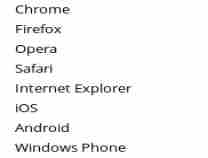
     You can find the type of the device using javascript, for example your website If you want to hide some features in particular device you can use this code. From this code you can find what type of device is it like Android, Windows Phone, ipod, ipad, iphone, chrome or firefox and etc..

The following method will return the useragent full details.

     navigator.userAgent
You can find is this is mobile device or not using the following code

     /(ipad|iphone|ipod|android|windows phone)/i.test(navigator.userAgent)
Mostly we need to check it for cordova mobile application, because we need to check it in desktop pc or in normal browser and mobile native application, in that situation we can check like below.

if(( /(ipad|iphone|ipod|android|windows phone)/i.test(navigator.userAgent) ))

{

cordova.plugins.Keyboard.close();

}


In the above method is only working in mobile, we can't run cordova methods in PC.


Example Program:- (Editor)


Editor is Loading...

Advertisement

Monday, 2 May 2016

     Usually we will two values from dropdown list one is option value and option text, but in some situation we need to get more values from dropdown options.


Example Program:- (Editor)


Editor is Loading...

Advertisement

     In the following code will get the image or any types of files from input type="file" html tag and convert the selected file into 64bit data url. The data url can use directly in the browser address bar.

Note:
The speed vary depending on the selected file size.


Example Program:- (Editor)


Editor is Loading...

Advertisement

Saturday, 16 April 2016

     Big numbers can write using the below format in javascript.


Example Program:- (Editor)


Editor is Loading...

Advertisement

Wednesday, 13 April 2016

     In javascript we can easy to convert any numbers to corespoinding hexadecimal, octal or binary value using toString() method.

Syntax

   variable.toString()      //convert to String
   variable.toString(2)    //convert to Binary
   variable.toString(8)    //convert to Octal
   variable.toString(16)  //convert to Hexadecimal

Example

   var num=66;
   num.toString();     //return "66"
   num.toString(2);   //return "1000010"
   num.toString(8);   //return "102"
   num.toString(16); //return "42"


Example Program:- (Editor)


Editor is Loading...

Advertisement

Monday, 11 April 2016

     The parseInt() function parses a string argument and returns an integer of the specified radix (the base in mathematical numeral systems).

Syntax

   parseInt(string, radix);

string
     The value to parse. If string is not a string, then it is converted to a string (using the ToString abstract operation). Leading whitespace in the string is ignored.

radix
     An integer between 2 and 36 that represents the radix (the base in mathematical numeral systems) of the above mentioned string. Specify 10 for the decimal numeral system commonly used by humans. Always specify this parameter to eliminate reader confusion and to guarantee predictable behavior. Different implementations produce different results when a radix is not specified, usually defaulting the value to 10.

Description
     The parseInt function converts its first argument to a string, parses it, and returns an integer or NaN. If not NaN, the returned value will be the decimal integer representation of the first argument taken as a number in the specified radix (base). For example, a radix of 10 indicates to convert from a decimal number, 8 octal, 16 hexadecimal, and so on. For radices above 10, the letters of the alphabet indicate numerals greater than 9. For example, for hexadecimal numbers (base 16), A through F are used.

     If parseInt encounters a character that is not a numeral in the specified radix, it ignores it and all succeeding characters and returns the integer value parsed up to that point. parseInt truncates numbers to integer values. Leading and trailing spaces are allowed.


  1. If radix is undefined or 0 (or absent), JavaScript assumes the following:
  2. If the input string begins with "0x" or "0X", radix is 16 (hexadecimal) and the remainder of the string is parsed.
  3. If the input string begins with "0", radix is eight (octal) or 10 (decimal).  Exactly which radix is chosen is implementation-dependent.  ECMAScript 5 specifies that 10 (decimal) is used, but not all browsers support this yet.  For this reason always specify a radix when using parseInt.
  4. If the input string begins with any other value, the radix is 10 (decimal).
  5. If the first character cannot be converted to a number, parseInt returns NaN.


For arithmetic purposes, the NaN value is not a number in any radix. You can call the isNaN function to determine if the result of parseInt is NaN. If NaN is passed on to arithmetic operations, the operation results will also be NaN.

To convert number to its string literal in a particular radix use intValue.toString(radix).

The following example return 15.
Example

   parseInt(" 0xF", 16);
   parseInt(" F", 16);
   parseInt("17", 8);
   parseInt(021, 8);
   parseInt("015", 10);
   parseInt(15.99, 10);
   parseInt("15,123", 10);
   parseInt("FXX123", 16);
   parseInt("1111", 2);
   parseInt("15*3", 10);
   parseInt("15e2", 10);
   parseInt("15px", 10);
   parseInt("12", 13);

The following example return NaN.
Example

   parseInt("Hello", 8); // Not a number at all
   parseInt("546", 2);   // Digits are not valid for binary representations

The following example return -15.
Example

   parseInt("-F", 16);
   parseInt("-0F", 16);
   parseInt("-0XF", 16);
   parseInt(-15.1, 10);
   parseInt(" -17", 8);
   parseInt(" -15", 10);
   parseInt("-1111", 2);
   parseInt("-15e1", 10);
   parseInt("-12", 13);

The following example return 224.
Example

   parseInt("0e0", 16);


Example Program:- (Editor)


Editor is Loading...

Advertisement

     The parseFloat() function parses a string argument and returns a floating point number. parseFloat is a top-level function and is not associated with any object.

     parseFloat parses its argument, a string, and returns a floating point number. If it encounters a character other than a sign (+ or -), numeral (0-9), a decimal point, or an exponent, it returns the value up to that point and ignores that character and all succeeding characters. Leading and trailing spaces are allowed.

     If the first character cannot be converted to a number, parseFloat returns NaN.

     For arithmetic purposes, the NaN value is not a number in any radix. You can call the isNaN function to determine if the result of parseFloat is NaN. If NaN is passed on to arithmetic operations, the operation results will also be NaN.

     parseFloat can also parse and return the value Infinity. You can use the isFinite function to determine if the result is a finite number (not Infinity, -Infinity, or NaN).

Syntax

   parseFloat(string);
The following all examples are return 3.14
Example

   parseFloat("3.14");
   parseFloat("314e-2");
   parseFloat("0.0314E+2");
   parseFloat("3.14more non-digit characters");


Example Program:- (Editor)


Editor is Loading...

Advertisement